
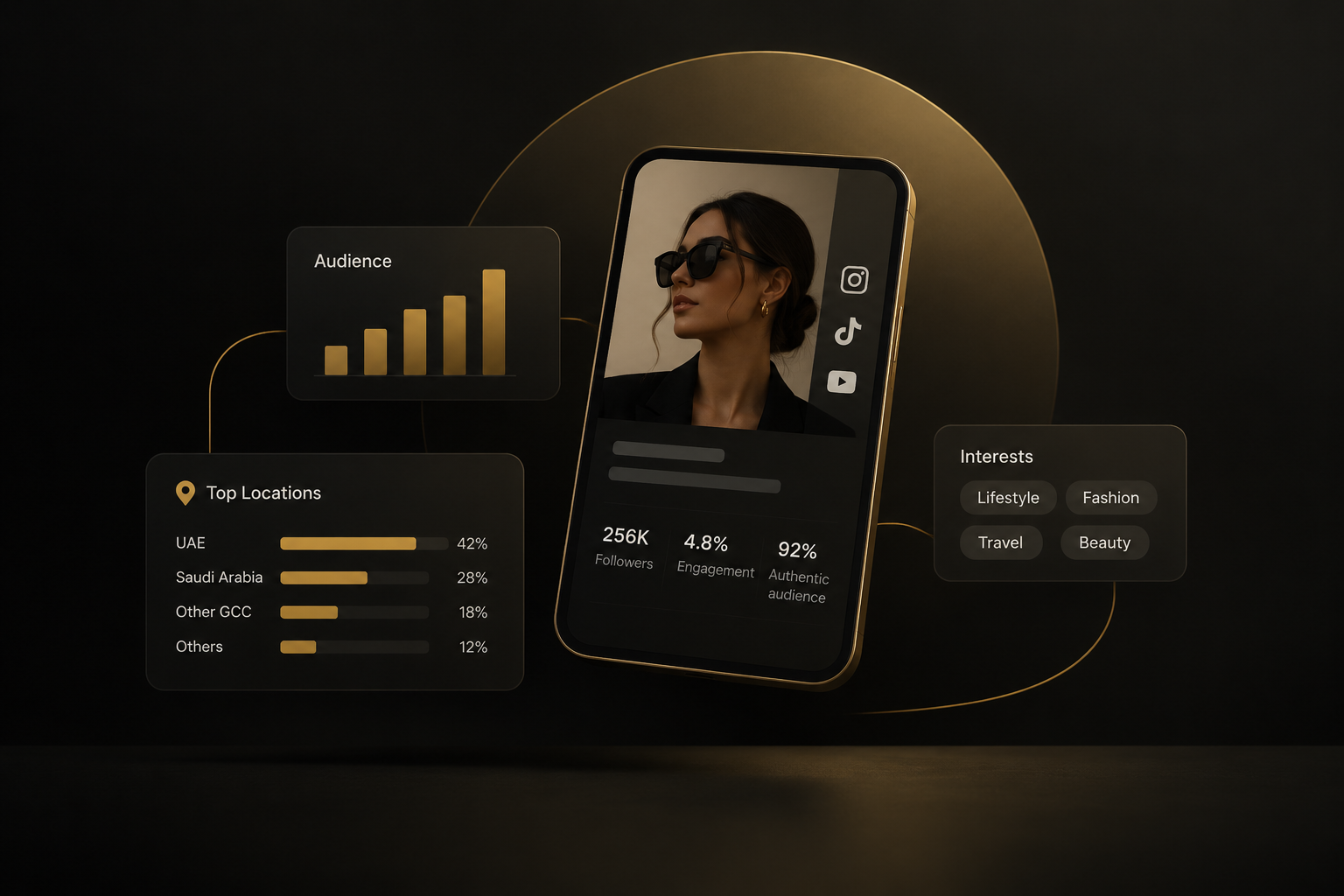
“Influencer intelligence” gets used loosely across the marketing industry, but the core idea is straightforward: it’s the data and analysis that tells you what an influencer’s following is actually worth, rather than what it appears to be worth. Industry glossaries define it broadly as the insight marketers gain into an influential profile’s real impact — reach, engagement, audience makeup, and how effectively that audience acts on a call to action. For brands running campaigns in Dubai, Riyadh, Doha, Manama, or Muscat, that definition is only the starting point. In a region with an unusually international creator base and five distinct national audiences, influencer intelligence has to answer a more specific question: will this creator actually move product with the audience I’m targeting?
Why Influencer Intelligence Exists
Influencer marketing grew fast enough that the basic selection method — search a hashtag, sort by followers, send a proposal — stopped being reliable years ago. Follower counts can be inflated with bought accounts, engagement can be manufactured through pods and bots, and a creator’s stated location often has little to do with where their actual audience lives. Brands that kept choosing influencers on follower count alone started seeing campaigns that generated impressions but no measurable lift in sales or awareness. Influencer intelligence is the response to that problem: a structured way of separating creators with real audience influence from creators who simply look influential on a profile page.
The Core Data Points Behind Influencer Intelligence
While every agency frames it slightly differently, most influencer intelligence work is built from the same handful of data categories:
Audience Authenticity — Follower growth patterns, engagement-to-follower ratio, and comment quality reveal whether an audience is real or partly purchased. A sudden follower spike with flat engagement is one of the clearest red flags.
Audience Location & Demographics — Where an audience actually lives matters more than where the creator is based. A Dubai-based creator can have a majority-international following with a small share of GCC followers, which is a poor fit for a market-specific campaign.
Engagement Quality — Comment sentiment and reply patterns say more than a like count. Generic comments and emoji spam usually indicate lower-quality engagement than specific, on-topic replies.
Content & Brand Safety History — Past brand partnerships and content tone show whether a creator is likely to represent a brand consistently and without reputational risk.
Performance Benchmarking — Click-through and conversion data, compared against category and market averages, shows whether a creator’s engagement historically translates into action.
Why This Matters More in the UAE and GCC
The UAE and wider GCC region present a specific challenge that influencer intelligence is built to solve: audience fragmentation. Dubai’s creator scene includes a large share of expatriate and international followers alongside a smaller core of UAE nationals and long-term residents, and that mix shifts again in Riyadh, Doha, Manama, and Muscat, each with different platform habits and content preferences. A creator with millions of followers globally can have a genuinely small footprint in the specific market a brand is trying to reach. Without country-level audience data, a brand can spend an entire campaign budget reaching the wrong people while every vanity metric on the report looks strong.
Language adds another layer. A creator posting primarily in English may under-index with an Arabic-speaking GCC audience even if their follower count in the region is high, while a bilingual creator with a smaller following can outperform on actual engagement and recall. Influencer intelligence surfaces this kind of detail before a campaign launches, not after the results come in.
How Brands Access Influencer Intelligence
There are generally two paths. Larger organizations sometimes build internal analytics capability using social listening platforms and in-house data teams, tracking creators across every relevant category over time. For most brands, that level of infrastructure isn’t practical for a single campaign, which is where an influencer marketing agency with an established vetting process becomes the more efficient option — the data collection and analysis happen before a shortlist ever reaches the brand, rather than after budget has already been committed.
The key question to ask any agency or platform offering “influencer intelligence” is not whether they have data, but whether that data is specific to the market a campaign is targeting. Global engagement benchmarks are of limited use to a brand launching in Riyadh; what matters is how a creator performs with a GCC or country-specific audience.
How OneHub Applies Influencer Intelligence
OneHub built its Creator Fit Score around exactly this gap. Every creator considered for a campaign is evaluated on audience authenticity, market relevance down to the country level, content and brand safety history, and performance benchmarking against category and market standards — the same categories described above, applied specifically to the UAE, Saudi Arabia, Qatar, Bahrain, and Oman. The result is a shortlist that has already been filtered for real audience fit before a brand sees a single name, and visibility into performance while a campaign is live rather than only in a wrap-up report.
The Takeaway
Influencer intelligence isn’t a buzzword layered on top of influencer marketing — it’s the difference between choosing a creator because they look right on paper and choosing one because the data says they’ll actually reach and move the audience a brand cares about. In a region as diverse and fast-moving as the UAE and GCC, that distinction is often what separates a campaign that performs from one that simply reports impressive-looking numbers.
Frequently Asked Questions
What is influencer intelligence in simple terms?
It’s the use of audience, engagement, and performance data to judge whether an influencer is genuinely right for a brand, rather than choosing based on follower count alone.
How is influencer intelligence different from influencer marketing?
Influencer marketing is the campaign itself — the content, the creators, the posting schedule. Influencer intelligence is the data and analysis used to plan that campaign, select the right creators, and measure whether it worked.
Why does influencer intelligence matter more in the UAE and GCC?
The region has an unusually international creator base, so a large following doesn’t guarantee a local or regional audience. Country-level audience data is essential before selecting a creator for a GCC-specific campaign.
What data points make up influencer intelligence?
Common data points include audience authenticity, audience location and demographics, engagement quality, content and brand safety history, and benchmarked performance against similar creators.
Can small businesses use influencer intelligence, or is it only for big brands?
It applies at any budget level. Avoiding wasted spend on the wrong creator matters most when budgets are small, not least.