
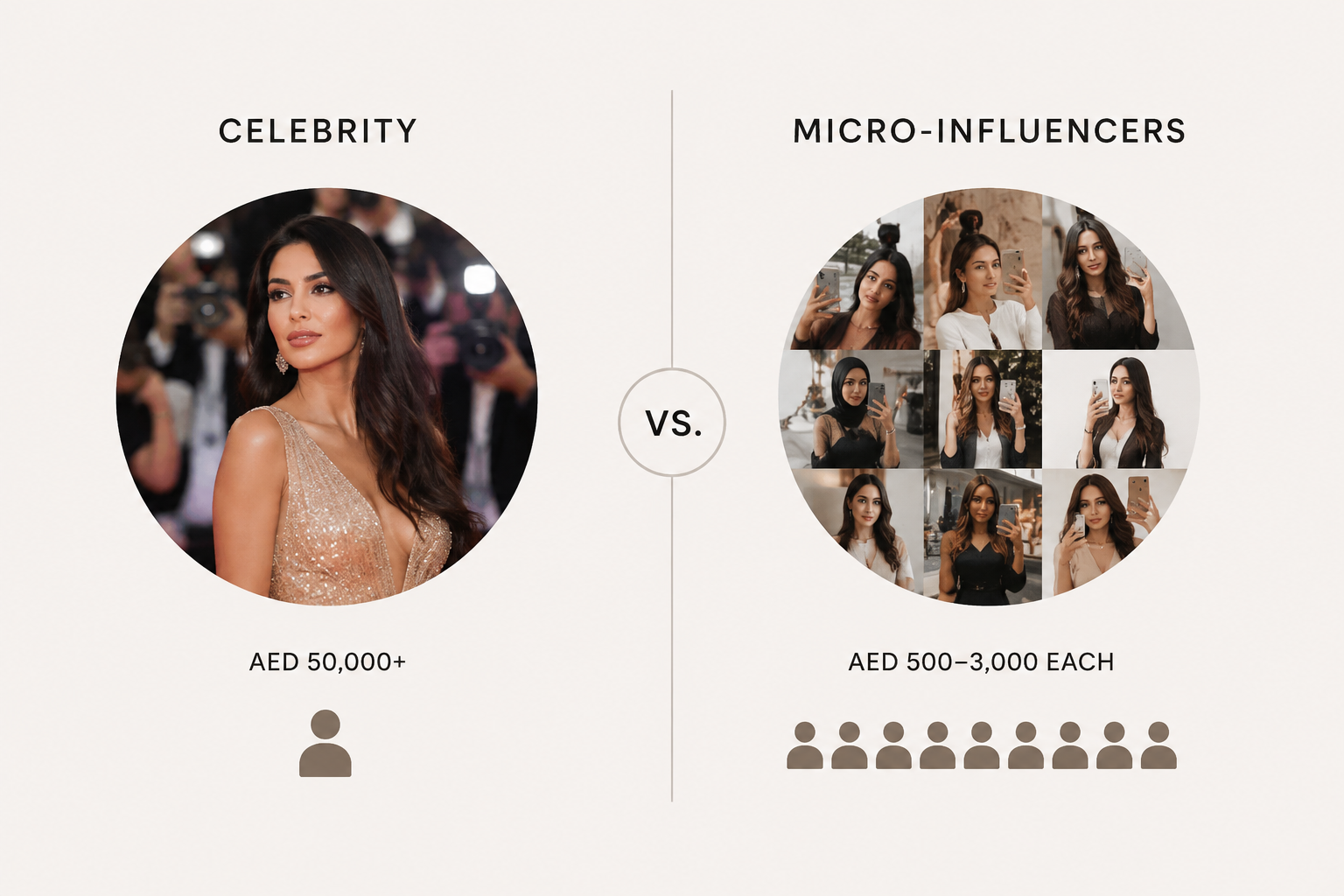
For years, the playbook for fashion marketing in the UAE looked the same: sign a celebrity or a mega-influencer, get one glossy post, hope it moves the needle. In 2026, that playbook is being quietly rewritten. Brands from independent Dubai labels to established GCC retailers are shifting a growing share of their budgets toward micro-influencers — and the numbers explain why.
The Cost Gap Is Bigger Than Most Brands Realize
A single sponsored post from a celebrity or top-tier UAE influencer can run AED 50,000 or more. For that same spend, a brand can work with 15–25 micro-influencers, each charging roughly AED 500–3,000 per post. That’s not a marginal difference — it’s an entirely different distribution strategy for the same budget.
The real story isn’t just cost, though. It’s what that cost buys. A celebrity post reaches a broad, often passive audience. A coordinated wave of micro-influencer content reaches dozens of tightly engaged niche communities — fashion students in Sharjah, modest-wear enthusiasts in Abu Dhabi, streetwear collectors in Dubai — each one primed to actually act on a recommendation rather than just scroll past it.
Why Engagement Rates Favor the Micro Tier
Across the influencer marketing industry, engagement rate tends to fall as follower count rises. Creators with 5,000–50,000 followers typically post to audiences who followed them for a specific reason — their taste, their honesty, their consistency — and that context makes recommendations land differently than a one-off celebrity endorsement.
In practical terms, brands running micro-influencer campaigns in the UAE are commonly seeing engagement multiples of 5–10x per dirham spent compared to celebrity placements, once you account for the total reach across a creator roster instead of a single account. It’s not that celebrities don’t work — it’s that their return per dirham rarely competes with a well-built micro roster once you’re optimizing for engagement rather than raw impressions.
Trust Is the Real Currency
UAE and GCC consumers, particularly the 18–35 demographic driving most fashion purchases, have grown noticeably more skeptical of obvious paid celebrity content. A micro-influencer filming a try-on haul in their own bedroom, talking through fit and fabric the way a friend would, reads as far more credible than a polished celebrity carousel — even when both are clearly sponsored.
This matters more in fashion than almost any other category, because purchase decisions hinge on questions a celebrity post can’t answer: How does this actually fit? Does the fabric feel cheap? Is it true to size? Micro-influencers, especially those who post honest before/after or try-on content, answer exactly those questions — which is why their audiences convert at higher rates.
What a Smarter Budget Split Looks Like
Brands making this switch aren’t abandoning big names entirely — they’re rebalancing. A typical 2026 campaign structure now looks less like “one celebrity, one moment” and more like a layered approach:
- A base layer of 15–30 micro-influencers (5K–50K followers) posting try-ons, styling content, and honest reviews over a sustained period rather than a single launch day
- A handful of mid-tier creators (50K–200K) to anchor reach and add polish to the campaign’s visual identity
- Selective use of one larger name or celebrity, reserved for a launch moment or a hero campaign, rather than as the default strategy
This layered structure also solves a problem celebrity-only campaigns can’t: content volume. A single celebrity post gives you one asset. Twenty micro-influencers give you twenty pieces of authentic UGC-style content that can be repurposed across paid social, the brand’s own feed, and email — multiplying the value of the same spend.
The GCC Context Makes This Even More Pronounced
Across Saudi Arabia, Qatar, Bahrain, and Oman, fashion audiences are increasingly segmented by lifestyle, region, and even dialect-level content preferences. A single celebrity campaign can’t speak to a modest-fashion audience in Riyadh, a resort-wear audience in Doha, and a streetwear audience in Dubai simultaneously — but a curated roster of regional micro-influencers can, because each creator already speaks that specific audience’s language.
This is where budget efficiency compounds: the same total spend that buys one broad celebrity moment can instead buy several parallel campaigns, each precisely targeted to a market segment, running at the same time.
Making the Switch Without Losing Brand Control
The hesitation brands often voice is about consistency — celebrities come with polish and predictability, while a roster of 20 micro-influencers can feel harder to manage. In practice, this is solved with clear creative briefs, defined do’s and don’ts, and a review step before content goes live, not by defaulting back to a single big name. Agencies that specialize in influencer sourcing and campaign management exist precisely to remove this friction, handling creator vetting, briefing, contracts, and reporting so the brand gets the reach benefits of a micro-influencer strategy without the operational overhead.
The Bottom Line for 2026
The shift isn’t a trend — it’s a budget correction. UAE fashion brands have realized that the same money spent on one celebrity post can fund a multi-week, multi-platform campaign with dozens of creators, each reaching a smaller but far more convertible audience. For brands evaluating where to put next quarter’s influencer budget, the math increasingly points toward micro.
Frequently Asked Questions
How much does a micro-influencer campaign cost in the UAE compared to a celebrity post?
Micro-influencers in the UAE typically charge AED 500–3,000 per post, compared to AED 50,000+ for a celebrity or top-tier influencer post. A campaign with 15–25 micro-influencers can often be run for the same or less than a single celebrity placement.
What follower count counts as a "micro-influencer" in the UAE fashion space?
Most agencies define micro-influencers as creators with roughly 5,000–50,000 followers, sitting between nano-creators (under 5K) and mid-tier or macro creators (50K–500K+).
Do micro-influencers actually drive sales, or just engagement?
When paired with trackable promo codes or affiliate links, micro-influencer campaigns commonly outperform celebrity posts on conversion, largely because their audiences trust their product opinions more and their content answers practical questions (fit, fabric, sizing) that drive purchase decisions.
Should fashion brands drop celebrities entirely?
Not necessarily — celebrities still have value for big launch moments and brand awareness. The more effective approach for most UAE fashion brands is a layered strategy: a broad base of micro-influencers for sustained engagement and conversion, with selective celebrity or macro-influencer use for major campaign moments.
How many micro-influencers should a UAE fashion brand work with per campaign?
Most effective campaigns use 15–30 micro-influencers to build meaningful reach and content volume, though this scales up or down depending on budget and how many audience segments (modest wear, streetwear, resort wear, etc.) the brand wants to cover.