
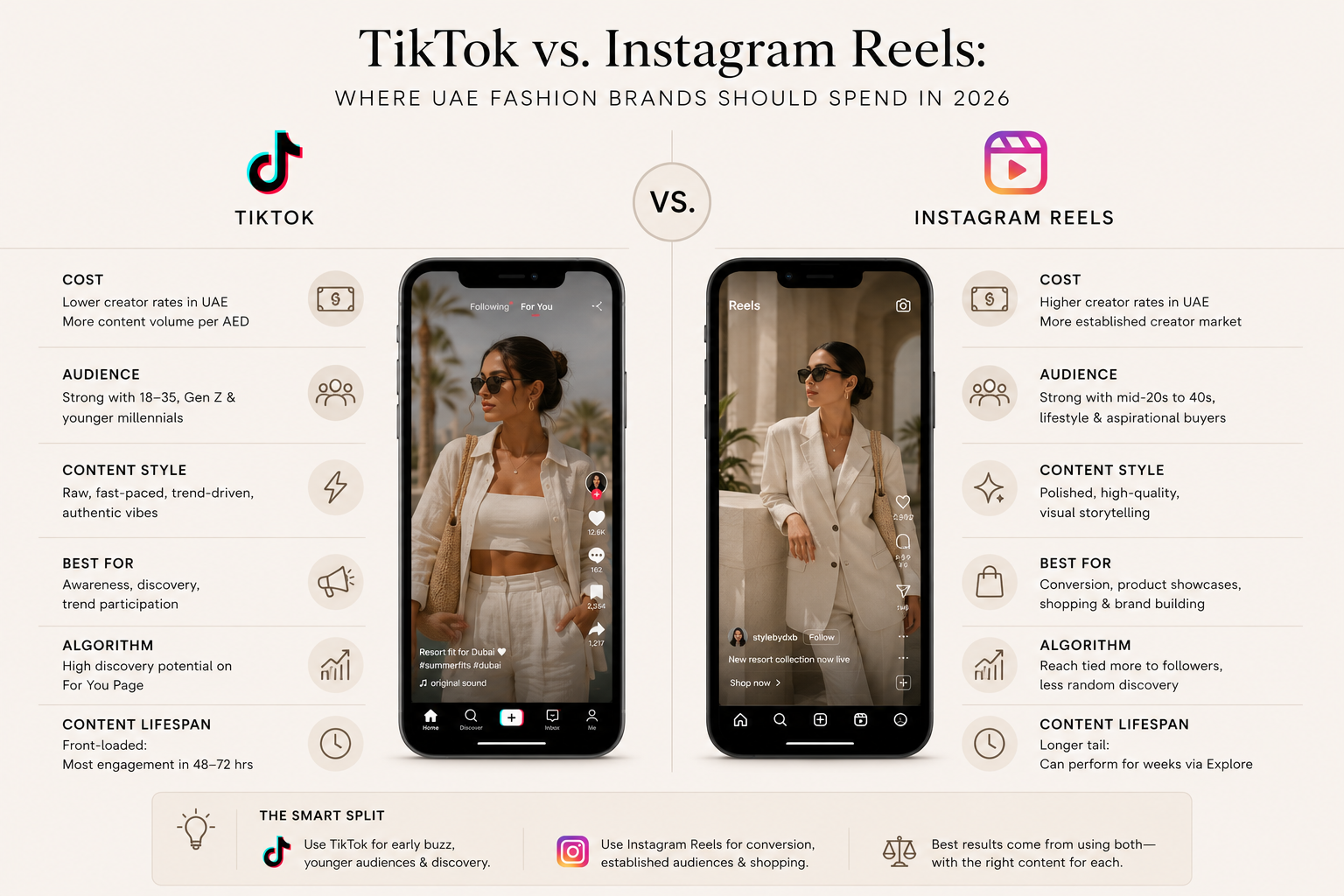
Every UAE fashion brand’s influencer budget conversation eventually lands on the same question: TikTok or Instagram Reels? The honest answer isn’t one or the other — it’s understanding what each platform actually does well, for whom, and building a split that matches the brand’s audience rather than defaulting to whichever platform is trending in the marketing press this month.
The Cost Reality
TikTok creator rates in the UAE generally sit lower than Instagram rates for comparable follower counts, particularly in the micro and mid-tier ranges. Part of this is platform maturity in the region — Instagram has been the default fashion and lifestyle platform in the Gulf for longer, so its creator economy is more established and rates have adjusted accordingly. TikTok’s creator market is catching up quickly, but brands can currently get more content volume per dirham there, especially when working with newer creators building their following.
This cost gap matters for budget-conscious brands, but it shouldn’t be the only factor. Cheaper reach that doesn’t reach the right audience isn’t actually cheaper.
Where the Audiences Actually Differ
Instagram Reels in the UAE still holds the stronger position with lifestyle, fashion, and aspirational content — the platform’s existing culture of polished visuals, Stories, and Shopping integration makes it a natural home for fashion brands, particularly ones targeting a slightly older or more established audience (mid-20s to 40s) with real purchasing power.
TikTok’s strength is concentrated more heavily in the 18–35 range, with particularly strong traction among Gen Z and younger millennial audiences across the UAE and wider GCC. Content on the platform tends to reward rawer, faster-paced, trend-driven formats over the polish that performs on Instagram. For fashion specifically, TikTok has become a genuine discovery engine — audiences use it to find new brands and styles in a way that increasingly resembles search behavior more than passive scrolling.
Content Format: Same Video, Different Expectations
A common mistake brands make is treating TikTok and Instagram Reels as the same distribution channel with two names — cross-posting identical content and expecting identical results. The platforms reward different things:
- TikTok favors speed, trend participation (sounds, formats, challenges), and a sense of spontaneity. Overly polished content can actually underperform because it reads as inauthentic to the platform’s culture.
- Instagram Reels still rewards higher production value, particularly for fashion, where visual quality directly signals brand quality. Reels also benefit from Instagram’s broader ecosystem — Stories, Shopping tags, and a brand’s existing follower base — in a way TikTok content can’t leverage.
Creators who post to both platforms typically adapt pacing, captions, and even camera angles between the two rather than uploading the same file twice — and campaigns that account for this in the brief consistently outperform those that don’t.
What This Means for Budget Allocation
For most UAE fashion brands in 2026, the smartest approach isn’t choosing one platform — it’s splitting budget based on campaign objective:
- Brand awareness and discovery among younger audiences → weight budget toward TikTok, where lower creator costs allow for higher content volume and trend participation
- Conversion-focused campaigns with an established, slightly older customer base → weight budget toward Instagram Reels, where Shopping integration and polished content still convert more reliably
- New product or collection launches → a genuine split, using TikTok for early buzz and trend-driven discovery, then Instagram Reels for the more considered, purchase-intent-heavy audience
Brands targeting the broader GCC — Saudi Arabia, Qatar, Bahrain, Oman — should note that platform preference can shift slightly by market. Saudi Arabia in particular has shown especially strong TikTok growth among younger audiences, while Instagram retains stronger footing across all four markets for higher-income, brand-conscious segments.
The Algorithm Factor
Both platforms’ algorithms reward different signals, which affects creator strategy as much as platform choice. TikTok’s For You Page can push content well beyond a creator’s existing follower base if it performs early, making it genuinely possible for a smaller creator’s content to outperform a larger creator’s reach — something that happens far less often on Instagram, where existing follower count still correlates more closely with reach.
This has a practical implication for campaign structure: TikTok campaigns benefit from working with a higher volume of smaller creators and letting the algorithm surface the best-performing content, while Instagram campaigns benefit more from careful upfront creator selection, since reach is more predictable but less prone to sudden discovery-driven spikes.
What Actually Moved Product
A few patterns emerged that are worth any brand’s attention. Try-on and honest review content consistently outperformed polished lifestyle shots on conversion, even when the lifestyle content had higher view counts. Audiences engaged with the aspirational content, but they purchased after the practical content — the creator explaining how a piece actually fit their body, moved when they walked, or handled a real Dubai afternoon.
Timing also mattered more than expected. Content that went live in the two weeks before the resort season peak converted meaningfully better than content posted earlier, even from the same creators — a reminder that influencer content, like any marketing channel, benefits from proximity to the actual purchase moment.
A Note on Longevity
Instagram Reels content tends to have a longer discovery tail — a well-performing Reel can continue generating views and engagement weeks after posting, particularly if it gets pulled into Explore. TikTok content is more front-loaded, with the vast majority of engagement happening in the first 48–72 hours. This affects how brands should think about campaign pacing: TikTok campaigns need tighter release scheduling around key moments (launches, drops, seasonal windows), while Instagram content has more flexibility to keep performing over time.
The Bottom Line
There’s no universal right answer between TikTok and Instagram Reels for UAE fashion brands in 2026 — there’s only the right answer for a specific campaign objective and target audience. Brands chasing younger, discovery-driven audiences at lower cost should lean TikTok. Brands prioritizing conversion among an established, slightly older customer base should lean Instagram. The brands seeing the strongest results aren’t picking a side — they’re running both, deliberately, with content and creator strategy adapted to what each platform actually rewards.
Frequently Asked Questions
Is TikTok cheaper than Instagram for influencer marketing in the UAE?
Generally yes, particularly for micro and mid-tier creators — TikTok’s creator economy in the region is younger and rates tend to be lower, though this gap is narrowing as the platform matures.
Which platform is better for fashion brand awareness in the UAE?
TikTok tends to perform better for awareness and discovery among younger (18–35) audiences, while Instagram Reels remains stronger for reaching an established, slightly older, higher-purchasing-power audience.
Should brands post the same content on both platforms?
Not identically — content performs better when adapted to each platform’s culture: faster, trend-driven, less polished for TikTok; higher production value and Shopping-integrated for Instagram Reels.
Does platform preference differ across GCC markets?
Somewhat — Saudi Arabia shows particularly strong TikTok growth among younger users, while Instagram remains strong across all GCC markets for brand-conscious, higher-income audiences.
How long does content stay relevant on each platform?
Instagram Reels can continue generating engagement for weeks via Explore, while TikTok content is heavily front-loaded, with most engagement occurring in the first 48–72 hours after posting.